Historical Ref-Plan replay
Recover candidate operations from real smell-removal commits, replay them, and retain records that are both executable and smell-eliminating.
ICSE 2027 paper project
Historical refactoring replay and sketch-driven navigation for repository-level code smell refactoring.
Paper introduction
Large language models can propose plausible refactoring directions, but repository-level code smell refactoring requires coordinated edits that preserve global behavior. AutoRefactor uses an executable Refactoring Plan (Ref-Plan) as an intermediate representation, combining IDE-native refactoring operations with AST-based edits.
The system mines real smell-removal history, replays candidate Ref-Plans to keep only executable and effective examples, builds a task-level Refactoring SPEC for new instances, and validates each generated plan with executability, compilation, testing, and smell elimination checks.
Approach
AutoRefactor turns developer refactoring history into reusable operation-level experience and applies that experience through a structured, checkable generation pipeline.
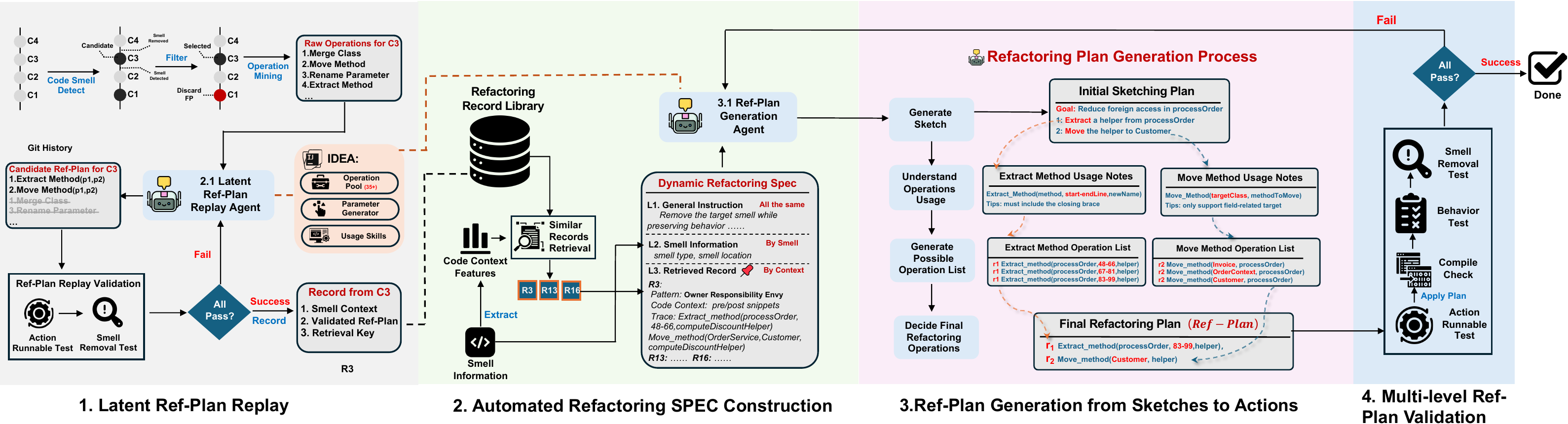
Recover candidate operations from real smell-removal commits, replay them, and retain records that are both executable and smell-eliminating.
Retrieve similar historical records and combine them with the current smell location, involved entities, constraints, and goals.
Generate a high-level refactoring sketch first, then bind it to concrete IDE and AST operations with explicit parameters.
Accept only plans that pass operation prechecks, compilation, tests, and smell-removal validation; use feedback to repair plans.
Evaluation
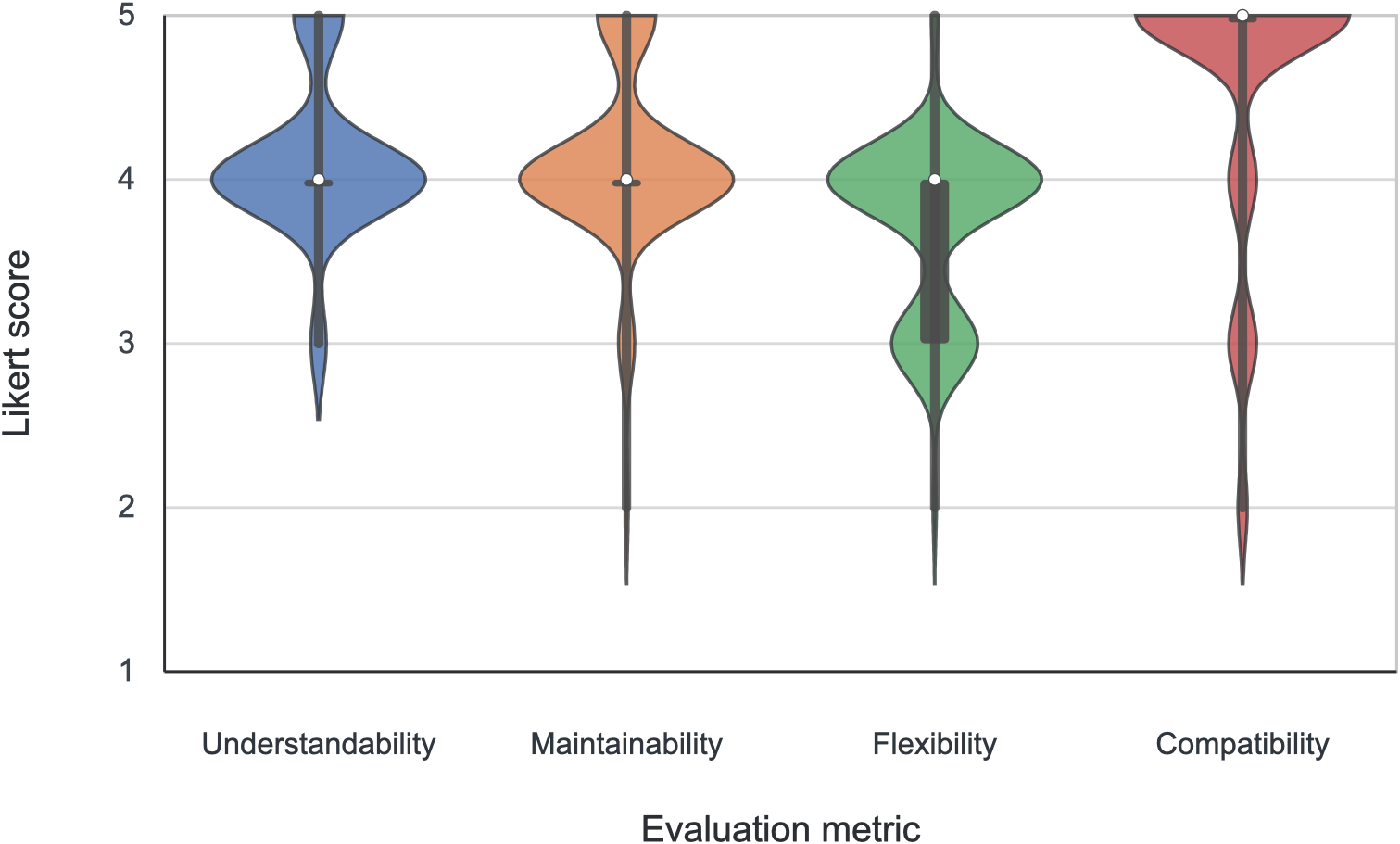
AutoRefactor was evaluated on 691 instances from 12 open-source Java projects and 9 code smell types. The evaluation compares specialized refactoring tools, a general coding-agent baseline, and ablated AutoRefactor variants.
Case study
The target is Apache Commons Compress
Segment.buildClassFile(int). The method repeatedly
accesses ClassBands, but it also coordinates class-file
assembly, constant-pool entries, source attributes, header defaults,
fields, interfaces, and bytecode metadata. A safe fix therefore
needs more than a direct move-method decision.
A baseline tool can identify and apply a plausible move-method change for this case, yet the resulting patch still fails validation. The example illustrates why AutoRefactor treats refactoring as a planned, checked repository-level change rather than a single candidate transformation.
private ClassFile buildClassFile(final int classNum) {
    final ClassFile classFile = new ClassFile();
    final int[] major = classBands.getClassVersionMajor();
    final int[] minor = classBands.getClassVersionMinor();
    if (major != null) {
        classFile.major = major[classNum];
        classFile.minor = minor[classNum];
    } else {
        classFile.major = header.getDefaultClassMajorVersion();
        classFile.minor = header.getDefaultClassMinorVersion();
    }

    final ClassConstantPool cp = classFile.pool;
    final int fullNameIndexInCpClass = classBands.getClassThisInts()[classNum];
    final String fullName = cpBands.getCpClass()[fullNameIndexInCpClass];
    final List<Attribute> classAttributes =
            classBands.getClassAttributes()[classNum];
    // Interfaces, fields, methods, and class attributes are assembled here.
}| Tool or run | Outcome | Validation summary | Reader takeaway |
|---|---|---|---|
| AutoRefactor GLM-4.7 / GPT-5 / GLM-4.5-Air / DeepSeek-V4-Flash | 4/4 Passed | All four model backends generate executable Ref-Plans and pass compilation, tests, and smell-elimination validation. | This case is not repaired by a one-off model response; it is consistently solved through a structured plan-execute-validate workflow. |
| MM-Assist | Rejected | A move-method patch is applied, but it fails validation. | Finding a candidate is not enough if the final patch is not safe. |
| FETruth | Not applicable | The matched target cannot be applied as an IDE refactoring. | A reported target still needs an executable transformation. |
| SWE-agent | Build failed | The edited repository does not pass the build check. | General-purpose editing struggles with this coordinated refactoring. |
| JDeodorant | No candidate | No applicable move-method candidate is produced. | Traditional candidate generation may miss this case entirely. |
This case shows why AutoRefactor validates a concrete refactoring plan against the repository instead of relying only on a local move-method suggestion.
Read brief case studyDemonstration
The demo shows AutoRefactor moving from smell context to sketch, Ref-Plan generation, and validation inside the development environment.
Artifacts
Downloadable artifacts for the AutoRefactor experiments, grouped by dataset, project snapshots, results, and the artifact README.
change-signature:classchange-signature:methodconvert-to-instance-methodcopy:filecopy:packagecopy:typedelete:fielddelete:methodencapsulate:fieldextract:classextract:constantextract:delegateextract:fieldextract:interfaceextract:methodextract:method-objectextract:parameterextract:superclassinline:methodintroduce:parameter-objectintroduce:variableinvert:booleanmake-static:methodmove:membermove:methodmove:packagemove:typepullUp:fieldpullUp:methodpushDown:fieldpushDown:methodrename:directoryrename:fieldrename:filerename:local-variablerename:methodrename:modulerename:packagerename:typereplace-inheritance-with-delegationdelete:filedelete:importdelete:statementdelete:typeinsert:fieldinsert:fileinsert:importinsert:methodinsert:statementinsert:typereplace:expressionreplace:fieldreplace:filereplace:methodreplace:statementreplace:typeupdate:fieldupdate:fileupdate:methodupdate:typeFixed Java smell dataset with 691 instances across 9 smell categories and source tables.
ProjectsSource snapshots of the 12 Java projects referenced by the dataset, plus local dependencies.
ResultsAgent, classic-tool, model-analysis, and human-evaluation result snapshots used in the paper.
GuideDirectory layout, included contents, exclusions, and local verification instructions.